


Anyone looking to buy a golf launch monitor or golf simulator will quickly encounter two different technologies: photometric camera systems and Doppler radar systems.
Both technologies can now provide extremely precise data. Nevertheless, there are significant differences – especially when the launch monitor is to be used indoors in a golf simulator.
The crucial question is therefore not necessarily:
Which technology is fundamentally more accurate?
But rather:
Which technology works best for my intended use and in my space?
That's exactly what we'll take a closer look at here.
What is a photometric launch monitor?
A photometric launch monitor primarily works with high-speed cameras.
These cameras observe the golf ball immediately before, during, and after impact. Within a very short time window, numerous images are captured, from which the system can determine ball speed, launch angle, launch direction, spin rate, and spin axis, among other things. Depending on the device, extensive club data is also recorded.
The big difference from classic radar systems is that the ball does not have to be tracked over several meters.
The crucial information is recorded directly around the moment of impact.
This is precisely why camera-based systems are particularly interesting for indoor golf simulators.
A typical example: Uneekor
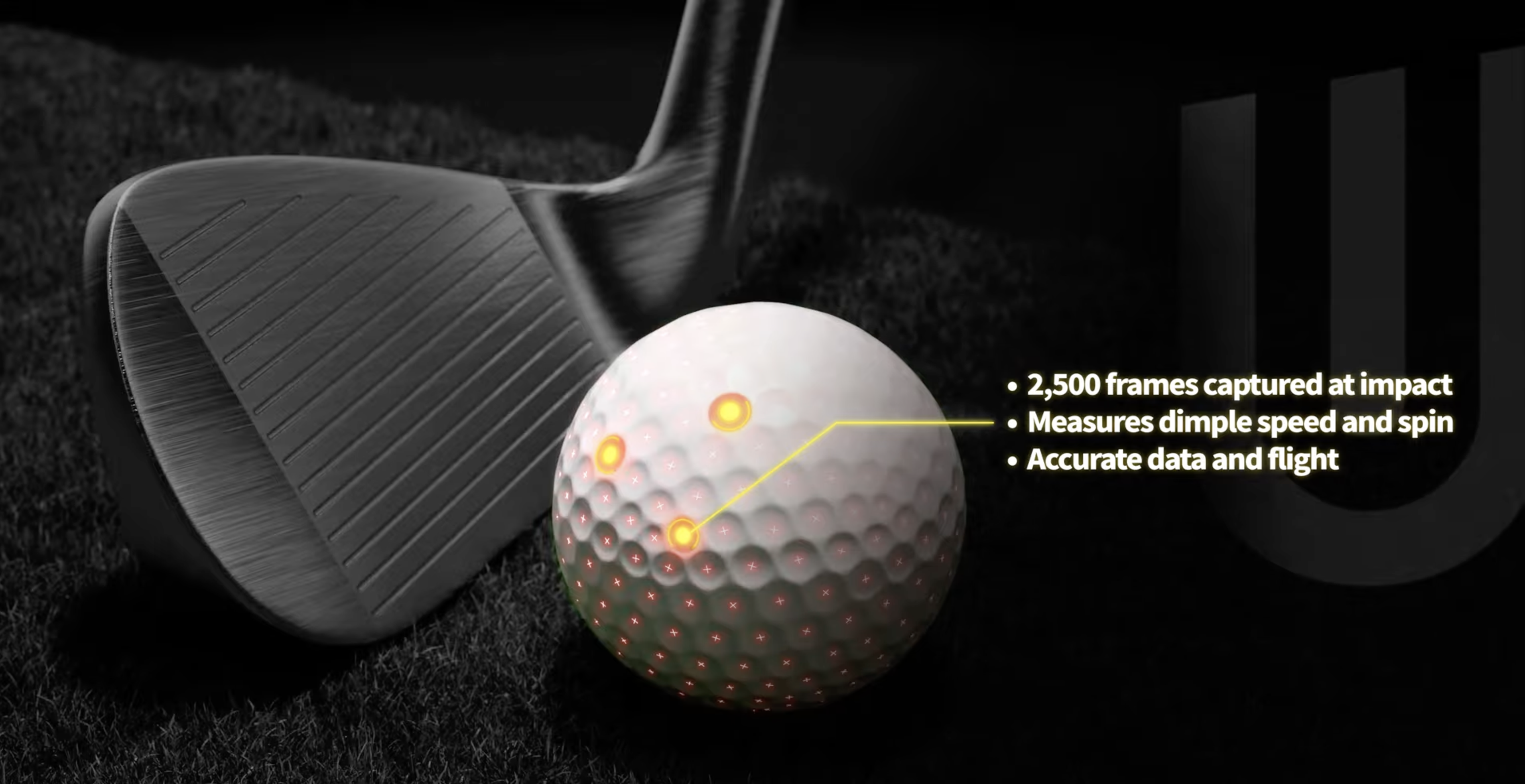
Uneekor heavily relies on high-speed cameras and infrared technology in its launch monitors.
In systems like the Uneekor EYE MINI, EYE XO, or EYE XO2, the ball's movement immediately after impact is optically analyzed. Technologies like Dimple Optix use the visible rotation or the structure of the golf ball to determine spin data.
Another advantage:
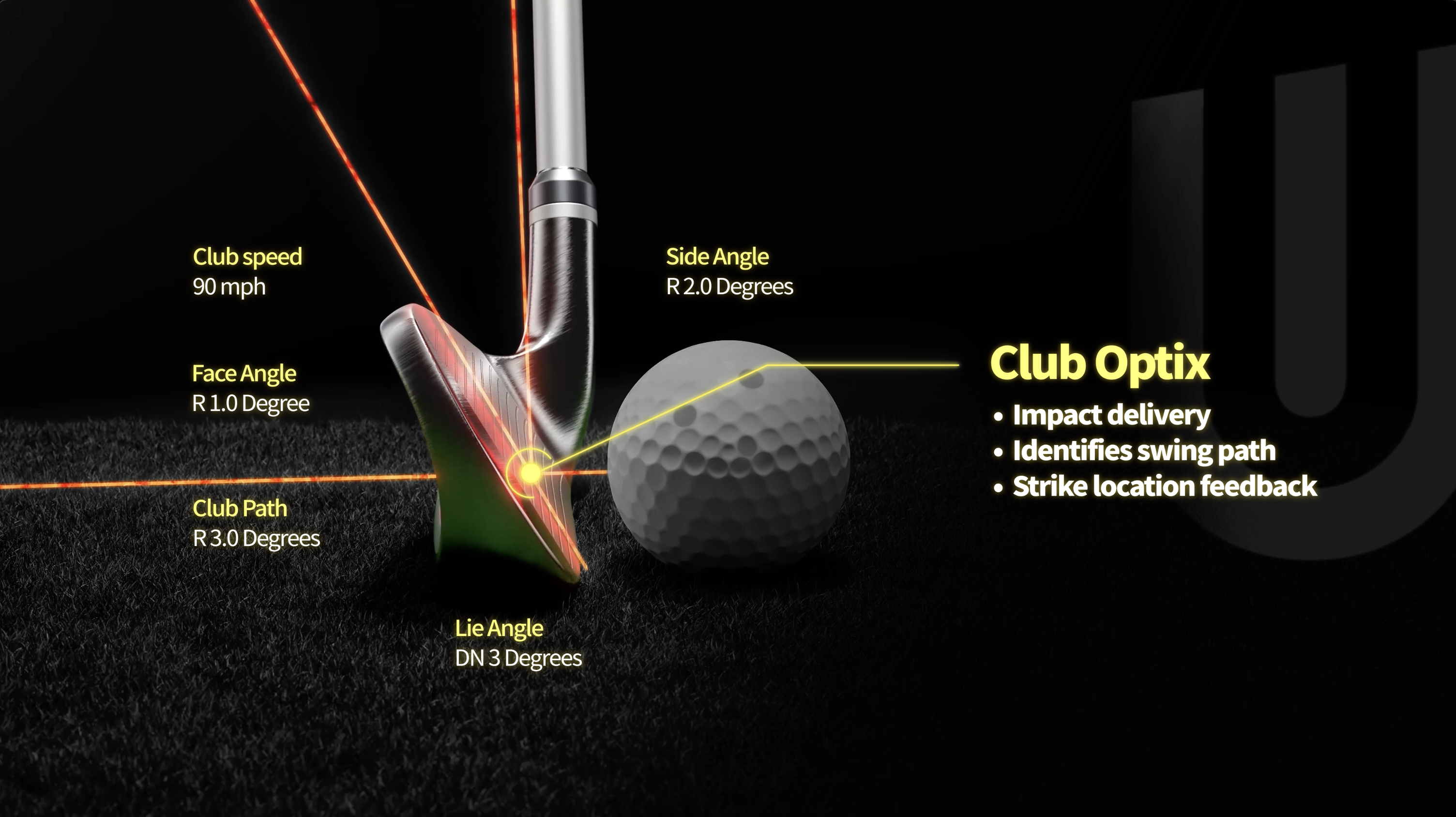
Some of these systems can also visually display the moment of impact or the club's movement.
This means the player not only sees numbers but can sometimes actually see what happened at impact.
Why does camera technology work so well indoors?
In a golf simulator, there's a crucial difference from a driving range:
The golf ball may only fly two to four meters before hitting the screen.
For a camera-based system, this is generally not a problem.
The most important data is already captured immediately after impact. It is therefore not necessary for the ball to fly another 50, 100, or 200 meters.
This offers several advantages in an indoor golf simulator.
Less room depth required
A camera-based launch monitor usually does not require a long ball flight.
Especially in:
- garages
- basements
- hobby rooms
- hotels
- indoor golf centers
- private golf rooms
this can be a significant advantage.
Particularly overhead systems are mounted directly on the ceiling and do not require additional space behind the player for a device.
What is a Doppler radar launch monitor?
Radar systems take a completely different approach.
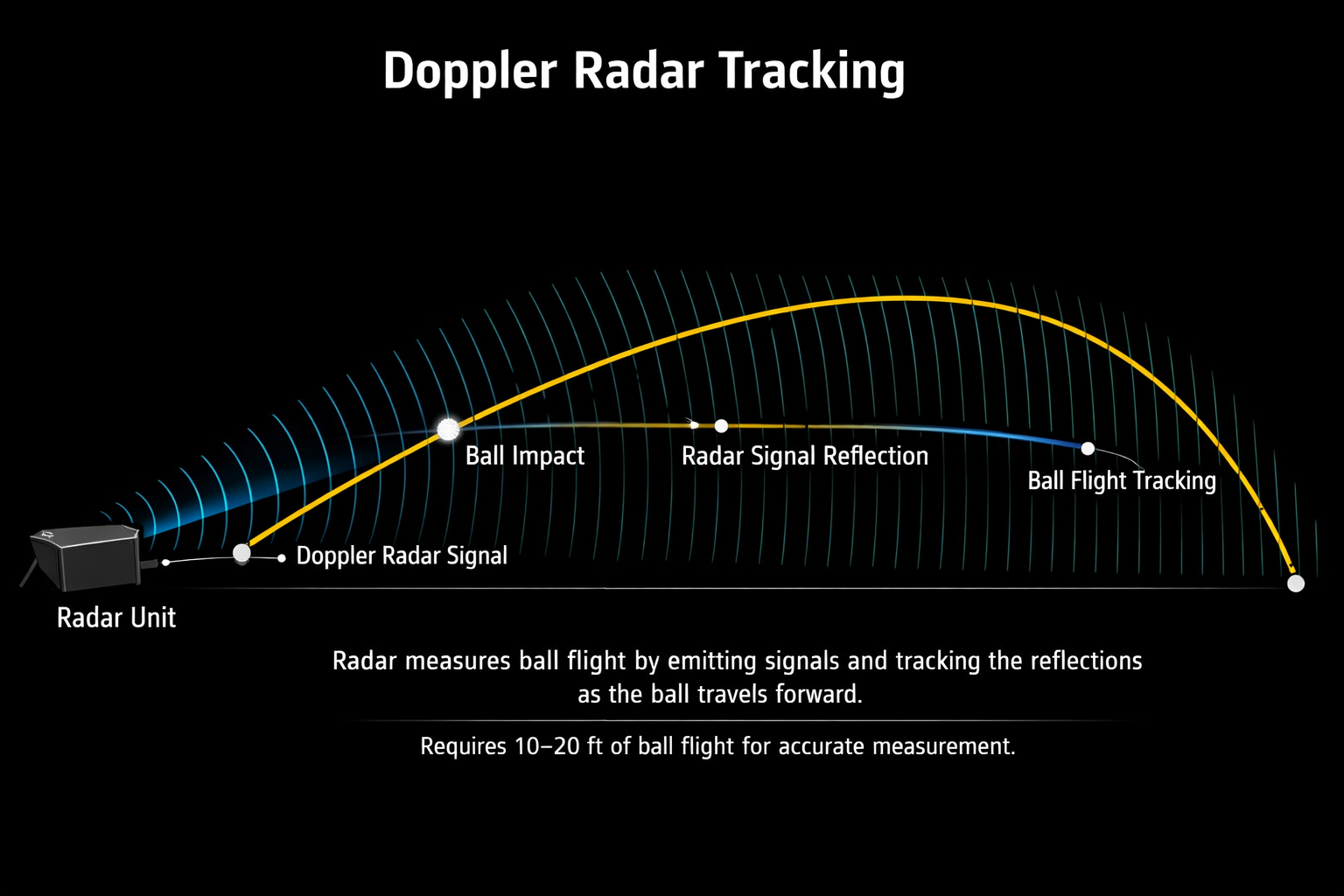
A Doppler radar emits electromagnetic signals and analyzes their change after they are reflected by the moving golf ball.
This allows the system to determine the ball's speed and trajectory, among other things. High-quality radar systems can track the ball outdoors over a large part or the entire ball flight.
And that's where one of radar's greatest strengths lies.
Radar is extremely strong outdoors
There is enough space on a driving range.
The ball actually flies 100, 150 or 250 meters, and a radar system can observe this flight over a long period.
This is a fundamentally different scenario than with an indoor golf simulator, where the ball hits the screen after just a few meters.
TrackMan 4, for example, combines dual Doppler radar with camera technology and is designed to track the ball even over its entire flight.
For players who want to use a launch monitor both on the driving range and indoors, such a concept can therefore be particularly interesting.
Does this mean that radar is inaccurate indoors?
No.
That statement would be far too sweeping today.
In the past, the two worlds could be relatively easily separated:
Camera = Indoor
Radar = Outdoor
It's not that simple anymore.
Modern manufacturers are increasingly combining different sensor technologies.
A good example of this is TrackMan iO.
The system, specifically developed for indoor golf, combines radar with a dual camera system and high-speed imaging. Among other things, 3D spin is measured directly. The system is mounted on the ceiling and does not require a classic long ball flight distance.
This increasingly blurs the classic line between "radar system" and "camera system".
Photometric vs. Radar: The most important difference
Simply put, the two technologies can be viewed as follows:
| Photometric systems | Radar systems |
|---|---|
| Observe ball and partly club with high-speed cameras | Track movements with radar |
| Very well suited for short indoor ball flights | Especially strong with long ball flight |
| Often available as an overhead system | Classically often positioned behind the player |
| Spin can be optically determined immediately after impact | Ball flight can be tracked over longer distances |
| Very good for fixed simulator installations | Often interesting for indoor and outdoor use |
| Low required ball flight distance | Classic radar systems benefit from more flight distance |
It is important to note, however: Modern premium systems can no longer always be clearly assigned to a single category.
TrackMan, for example, combines radar and camera, while manufacturers like Uneekor heavily rely on photometric high-speed systems.
Which technology is better for an indoor golf simulator?
When it comes to a permanently installed indoor golf simulator exclusively, photometric or camera-based systems offer some very practical advantages.
They require little ball flight, can be mounted directly above or next to the hitting area, and provide the relevant data immediately around the moment of impact.
Especially in normal private rooms, this is a crucial point.
A room is rarely 10 or 15 meters long, after all.
With a good camera-based system, this hardly matters.
The ball only needs enough space to be detected by the system after impact before it hits the impact screen.
Another advantage: free playing area
Overhead launch monitors are particularly interesting.
Systems such as:
- Uneekor EYE XO
- Uneekor EYE XO2
- Uneekor EYE XR
- ProTee VX
are mounted in or above the hitting area.
This means no device stands behind or next to the player on the ground.
This is not only aesthetically cleaner, but also very practical, especially for a golf simulator used by multiple people.
With a sufficiently large hitting area, right- and left-handed players can play without the launch monitor having to be repositioned each time.
When is radar the better choice?
Radar remains an excellent technology.
A mobile radar system can be particularly useful if the launch monitor is to be used regularly outdoors on the driving range.
Anyone who trains indoors in winter, for example, but wants to take the device to the range or golf course in summer, can benefit from a mobile radar system.
Especially there, radar can play to its great strength:
tracking the actual ball over a much longer flight path.
And what about spin?
Spin is one of the most important parameters of a launch monitor.
This is not just about the pure spin rate.
Crucial factors include:
- Spin Rate
- Spin Axis
- Launch Direction
- Launch Angle
- Ball Speed
Ultimately, these data points create the virtual trajectory of the golf ball.
Photometric systems can analyze the ball's rotation directly using high-speed recordings. Uneekor, for example, uses the ball's surface or dimples in its Dimple Optix technology to determine rotation.
However, modern hybrid systems can also directly capture spin. Systems like TrackMan iO combine high-speed cameras and radar for this purpose.
Therefore, when buying, one should not only ask:
"Radar or camera?"
Much more important is:
Which parameters are actually measured, which are calculated, and under what conditions does the system work optimally?
Which launch monitor is right for me?
The answer mainly depends on the intended use.
Fixed home golf simulator
Here, in many cases, we would lean towards a photometric or overhead-mounted system.
The small space requirement and reliable detection with short ball flight distance are clear advantages.
Indoor Golf Center
Overhead systems are also particularly interesting here.
The devices are located outside the immediate playing area and usually do not need to be readjusted after each player.
Teaching and Clubfitting
Here, the decision depends more on the required data and the desired software system.
Camera, radar, and hybrid systems can all represent interesting solutions.
Mainly Driving Range
Here, a mobile radar system remains a very interesting option.
The long real ball flight offers radar optimal conditions.
Indoor and Outdoor with one device
Here, one should specifically consider systems that were developed for both applications.
TrackMan 4, for example, is designed precisely for this combination and combines radar with optical support.
Our conclusion: Technology alone is not the deciding factor
The discussion of photometric vs. Doppler radar is often conducted as if one technology must be fundamentally better than the other.
In practice, it's not that simple.
Radar excels at tracking a golf ball over a long flight path.
Photometric high-speed systems, on the other hand, can capture an enormous amount of information immediately around the moment of impact and require very little ball flight to do so.
And modern premium systems sometimes already combine both technologies.
For a classic indoor golf simulator, camera-based or photometric systems are therefore the most practical solution in many cases.
Especially systems from Uneekor have consistently specialized in this area and offer various solutions, from mobile launch monitors to permanently installed overhead systems. However, Protee offers an alternative in the mid-price segment that should also be considered.
If, on the other hand, you are looking for maximum flexibility between the driving range and indoor golf, you should also include radar and hybrid systems in your selection.
Ultimately, the question should therefore not be:
"Which technology is better?"
But rather: